The Global Sourcing Landscape: Why China Remains a Leading Hub
China continues to be the world's leading manufacturing base for industrial control room furniture, offering mature supply chains, advanced production capabilities, and competitive pricing. Three primary manufacturing clusters stand out:
Pearl River Delta (Guangdong & Shenzhen): Excels in electronics integration and export logistics, with strong OEM/ODM capabilities.
Yangtze River Delta (Zhejiang & Jiangsu): Known for large-scale, vertically integrated manufacturing, often with facilities exceeding 20,000m².
Northern Industrial Belt (Beijing, Tianjin, Hebei): Specializes in intelligent control systems and high-precision engineering, supported by proximity to research institutions.
When evaluating a command center console supplier in China, geographic location should be considered alongside technical expertise, production capacity, and delivery performance.
Five Critical Technical Metrics for Console Procurement
Professional consoles must withstand 24/7 operation. Here are the key technical benchmarks to verify with any potential supplier:
1. Structural Durability: Steel-Aluminum Construction
Standard wooden desks warp under continuous use. Professional-grade consoles should feature high-strength cold-rolled steel (SPCC) and aluminum profiles to ensure decades of industrial stability and high load capacity.
What to verify: Request material specifications and third-party structural integrity test reports.
2. Cable Management: Integrated Power and Data Isolation
A superior console includes universal integrated cable trays that physically isolate power lines from signal cables, preventing electromagnetic interference (EMI). Hidden cable channels should accommodate a defined cross-sectional area, with all visible cabling minimized.
What to verify: Request the cable channel specification (cm²) and demand photos of internal cable routing from delivered projects.
3. Ergonomic Certification: Compliance with International Standards
Ergonomic design is not optional for 24/7 command centers. Consoles should comply with ISO 11064-4 (ergonomic design of control centres-workstation layout and dimensions) and ISO 9241-5 (workstation ergonomic requirements).
Key ergonomic parameters to evaluate:
Desk height adjustment range (mm)
Desktop curvature radius (R-value)
Keyboard tray tilt angle adjustment range (°)
Knee clearance in seated operating position
What to verify: Request a third-party ergonomic test report, focusing on "forward neck angle" and "lumbar pressure distribution" data measured under continuous 4-hour operation conditions.
4. Surface Material: Fire-Retardant HPL vs. Basic Coating
With dense electronics in close proximity, fire safety is critical. High-Pressure Laminate (HPL) surfaces offer flame retardancy, scratch resistance, and ease of cleaning. Industrial-grade surface treatment should meet pencil hardness and color difference (ΔE) specifications.
What to verify: Request third-party coating test reports, including adhesion grade and chemical resistance data.
5. Scalability: Modular Design for Future Expansion
Control rooms evolve. A modular console design allows you to add seats, change monitor configurations, or reconfigure layouts without replacing the entire structure, protecting the end-user's long-term investment. Standardized mounting interfaces are essential.
What to verify: Request case studies showing console expansion from smaller to larger configurations, with before-and-after documentation.
Quality Assurance and Certifications
A reputable command center console manufacturer should hold the following certifications:
| Certification | What It Covers |
|---|---|
| ISO 9001 | Quality management system |
| ISO 45001 | Occupational health & safety |
| CE | Electrical safety, insulation, EMC compliance |
Application Scenarios: Matching Consoles to Operational Needs
Different command environments demand different console configurations:
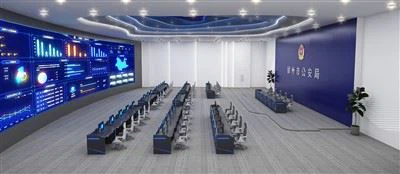
Emergency Dispatch & Public Safety - Consoles require unified communication system integration, touchscreen operation capability, and rapid dispatch functionality. Modular designs that support multi-agency coordination are preferred.
Energy & Utility Dispatch - DCS console integration is essential, with support for sit-stand systems and curved console designs for optimal screen visibility. In overseas power plant projects, DCS consoles are used to display turbine speed, boiler pressure, and ESP voltage data.
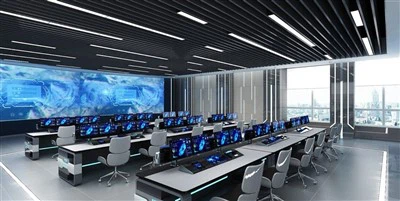
Transportation Management - Traffic management centers require consoles arranged in multiple rows facing video walls, with integrated surveillance systems and real-time decision-making capabilities.
Data Center & Network Operations Centers - Low-light environments demand consoles with appropriate color themes and centralized monitoring platforms. Space-efficient designs and KVM integration are key considerations.
How to Evaluate a Supplier: A Practical Checklist
When requesting quotes from command center console manufacturers, ask for the following:
Project case list from the past 12 months, including project names and deployment scenarios
Third-party test reports for ergonomics, structural integrity, and fire resistance
Certification documents (ISO, CE, etc.)
Production capacity data - facility size, number of technicians, monthly output
Customization capability - OEM/ODM experience, custom color matching, branding options
After-sales support - warranty terms, spare parts availability, technical documentation
A supplier's reorder rate can also serve as an indirect indicator of client satisfaction and product reliability.
Sourcing Strategy for Global Buyers
For international procurement teams, working directly with a factory rather than through trading intermediaries typically yields better pricing, faster customization, and clearer communication on technical requirements. Look for manufacturers that:
Provide English-language technical documentation and sales support
Have experience with international shipping and export compliance
Offer flexible MOQs for initial orders and scalable capacity for volume production
Can provide virtual factory audits or welcome on-site inspections
Conclusion: Building Long-Term Partnerships
Choosing a command center console manufacturer is not a one-time transaction-it is the beginning of a long-term operational partnership. Prioritize suppliers who demonstrate technical expertise, certified quality, modular design thinking, and a track record of successful project delivery across mission-critical environments.
If you are currently evaluating command center console suppliers for an upcoming project, we welcome the opportunity to discuss your requirements and provide a tailored proposal.